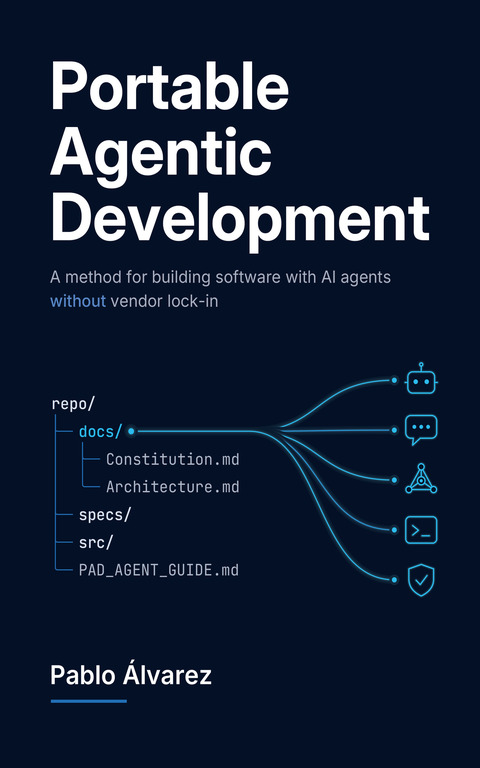
Build software with AI agents without vendor lock-in.
PAD is a method for working with coding agents — Claude Code, Cursor, Codex,
Gemini, any of them — that keeps a project's context inside the
repository, where it stays portable, reviewable, and yours.
The project's context belongs to the project, not to the tool.
— the root principle
Four ideas that keep your project independent of any single tool.
Agentic tools change every quarter; a serious project outlives all of them.
PAD puts the context an agent needs into the repository itself, so the work
survives the churn — and any agent can pick it up without reconstruction.
Context in the repo
The rules, the architecture, the decisions — in tool-agnostic files under /docs/, not in a vendor's memory. Thin adapters (AGENTS.md, CLAUDE.md, .cursor/rules) point every tool there.
Coupled commits
Every behavioral change moves code, tests and docs together — so the Git history becomes a readable architectural log.
The TPEV cycle
Think, Plan, Execute, Verify. The human approves before code is written; verification is visible, not assumed.
Reversibility
Small atomic commits on branches mean any step can be undone with git revert in seconds. Mistakes stop being expensive.
Where to start
Three ways in, depending on how far you want to go.
Read the method, put it to work for free, or get the tooling that generates and enforces it.
The book
Read the method
The full account of PAD — its origin, principles, the cycle, adapters and Skills, and how it differs from Scrum, XP and DevOps. Where to begin if you want the why.
PAD v1.8 · First edition, revised · November 2026 · 152 pages